top of page

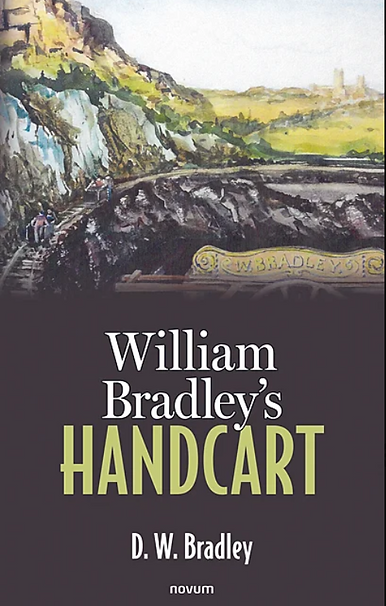
William Bradley's Handcart, is the first novel written by the author D W Bradley. A historical fiction, based on the early life of William Bradley, the author's great Grandfather. 

"William Bradley, the grandson of a successful Yorkshire businessman, is determined to make his mark on the world. Spurred on by the ambition to carve out a promising future for himself and his family, William defies tradition and succeeds against the odds."

Prologue

A Meeting of Minds
Yarm: 24th April 1764


Michael Bradley was pleased to find a seat in the new house at Yarm. He had watched the octagonal building rise from the ground for over a year. In his opinion, it was the newest and grandest building in Yarm. He was proud of the part that he had played in its construction. Although he was not responsible for the design, he had dressed the stone and his hands had built his place of worship. It was “his” church. Others could take credit for drawing up the plans, raising the money and promoting the cause but he and some of his contemporaries had made it. He was eighteen years of age and felt that he had done something worthwhile for the community.
It was early evening, and the house was filling up. He could see George Merryweather at the front nearest the lectern. He led the Methodists in Yarm and was responsible for purchasing the land. Michael could see him smiling at all the local dignitaries and no doubt congratulating himself on engaging Mr Wesley for tonight’s service. Wesley had visited Yarm before, and he had advised Merryweather on the design for the house. Michael had been told that Wesley wanted an octagonal shape so that ‘there are no corners for the devil to hide in’. It was an idea that Michael liked but he suspected that the novel shape of the building had more to do with breaking with normal church design and helping the preachers to be heard.
Tonight was special. Wesley had been unable to attend the opening because of commitments in Bristol but one of his preachers, Peter Jaco, had led the opening service. Michael had heard about Wesley but never seen him. All of the pews were now full and people continued to flood into the rear of the house. Members of the growing crowd whispered to each other about Wesley’s previous visits and speculated on his chosen topic for tonight. Little by little the whispering withered on the air as the great man entered the new house.
Michael strained to see round the shoulders of the crowd. Wesley’s bright blue eyes darted round the crowd and building. He missed nothing. He could see that his audience was large and mixed. Just the way he liked it. Farm workers, miners, builders, landowners, and businessmen had been drawn to hear him. There was also an assortment of rivermen who plied the River Tees. Yarm was a thriving inland port. Wesley was smaller than Michael had imagined, and he had to bend and twist to catch sight of the famous man. Michael could see him scanning the wooden roof timbers, the semicircle of pews and the upper gallery. The corners of Wesley’s mouth rose into a half smile as he absorbed more details about the building. Most of his advice had been accepted. He ascended the stairs to the pulpit, and it was only then that Michael could see him clearly.
Michael knew about the long hair, the distinctive nose, the flowing cloak, and the long rides on horseback but he had expected someone much taller. Tinged with guilt, he hoped that Wesley would not notice his ever-reddening cheeks.
The great man began.
“My text is taken from Saint Paul’s first letter to the Corinthians, chapter thirteen verse three.” His voice was neither loud nor soft. It was warm and invited attentiveness. “Though I bestow all my goods to feed the poor, and though I give my body to be burned, and have not love, it profiteth me nothing.” As he spoke, Wesley eyed his audience so that every member of his congregation felt that he was being personally addressed. They hung on every word. His charisma sprang from a sincere belief in his own words and an unflinching desire to assert that he was no better than those that listened to him. “Nor am I that speak the word of God any more secure from these dangers than you that hear it. I, too, have to bewail ‘an evil heart of unbelief’. Believe in the Lord Jesus Christ, and thou shalt be saved.”
Michael had heard similar phrases before, and they were often delivered with more power, variety and colour but Wesley’s words were carefully chosen, and each seemed imbued with total belief. He was no actor, and his gestures were not histrionic like so many others that Michael had heard from the pulpit. He found himself warming to this man and his words. According to Saint Paul, Wesley affirmed that helping the poor was not a matter of simply being virtuous but more a question of making a choice coolly and from a right principle. Michael agreed with these sentiments and welcomed them in the knowledge that many sought to help the poor purely to serve their own vanity. He had no time for such people. It was precisely this preoccupation with self-interest that had driven him from the established Church of England and into the arms of the Methodists.
“He that hath ears to hear, let him hear.” Michael heard, understood, and accepted.
“Love suffereth long or is longsuffering. If thou love thy neighbour for God’s sake, thou wilt bear long with his infirmities; if he wants wisdom, thou wilt pity and not despise him; if he be in error, thou wilt mildly endeavour to recover him, without any sharpness or reproach; if he be overtaken in a fault, thou wilt labour to restore him in the spirit of meekness.” Many of Wesley’s words rang true for Michael.
There was an almost imperceptible increase in the volume and capacity of Wesley’s delivery. The crowd were with him, and he drew strength from their tacit support.
“Does any man find in himself ill-will, malice, envy, or any other temper opposite to kindness? Then is misery there; and the stronger the temper, the more miserable he is. If the slothful man may be said to eat his own flesh, much more the malicious, or envious. His soul is the very type of hell – full of torment as well as wickedness. He hath already the worm that never dieth, and he is hastening to the fire that never can be quenched.”
Michael was resolved. He would never return to the Church of England, and he would support the Methodist movement for as long as he lived.

D.W. Bradley

D.W. Bradley is a writer and author of both children's books and a fiction novels. Based in Whitby North Yorkshire in the U.K.  

For more information contact 

bottom of page